Skip to content

ESG · Sustainability

Fewer wasted journeys. Less unnecessary work.

Environmental impact often comes down to ordinary decisions. Does a van make a trip for one task? Do we print something a guest could read on their phone? Do we heat a room with nobody in it? We show where Leviathan can help with those choices, and make it clear which figures are measured and which are estimates.

A managed portfolio on a single planned round
Scroll to follow changes in the route, paper use, heating and server capacity.

One 12-property portfolio, one year

1,600km

not driven

optimised rounds and call-outs that never happened

4,600sheets

not printed

forms, worksheets, house rules, invoices

3,500kWh

not consumed

setback in empty rooms and consolidated hosting

1.1t CO₂e

avoided

the three lines above, added up

A modelled estimate, not an audited measurement. Every assumption and emission factor is itemised under “How we calculate”.

Starting point

Moving a task onto a screen is not a saving by itself.

A digital form changes little if someone still has to drive over to collect it. We look for changes in the real work: fewer journeys, less printing and fewer hours heating empty rooms.

  • Running the system uses energy too.

    Every page load and background job takes energy. We aim for light interfaces, cached requests and background work only when there is a reason for it.

  • The bigger change often happens on site.

    A service visit or heating an empty building can outweigh the energy used to run software. We start with the daily decisions that may avoid journeys, paper and unnecessary energy use.

  • We call an estimate an estimate.

    We do not buy carbon offsets or claim to be carbon neutral. We keep measurements and modelled results separate, and show the assumptions behind our calculations.

Six concrete mechanisms

Six everyday decisions that can make a difference.

Each scene follows a familiar working day: what happened before, what changes in the plan, and what effect the model estimates. Scroll to see the difference.

Field logistics

The same stops, with fewer detours.

Cleaning, inspections and small repairs often take a team to the same neighbourhood, but in separate trips. Flow orders tasks by address, time window, type of work and required skill. The person driving gets a more considered route through the day; the team does the same work with less backtracking.

  • A daily round planned by address and time window, not by arrival order
  • Cleaning, inspection and small repairs merged into one visit
  • A cancelled booking drops out of the round immediately — no wasted trip
  • The route actually driven stays measurable and exportable

Distance driven / property / month

−43%

With manual scheduling12.4 km
With Flow round planning7.1 km
Related module
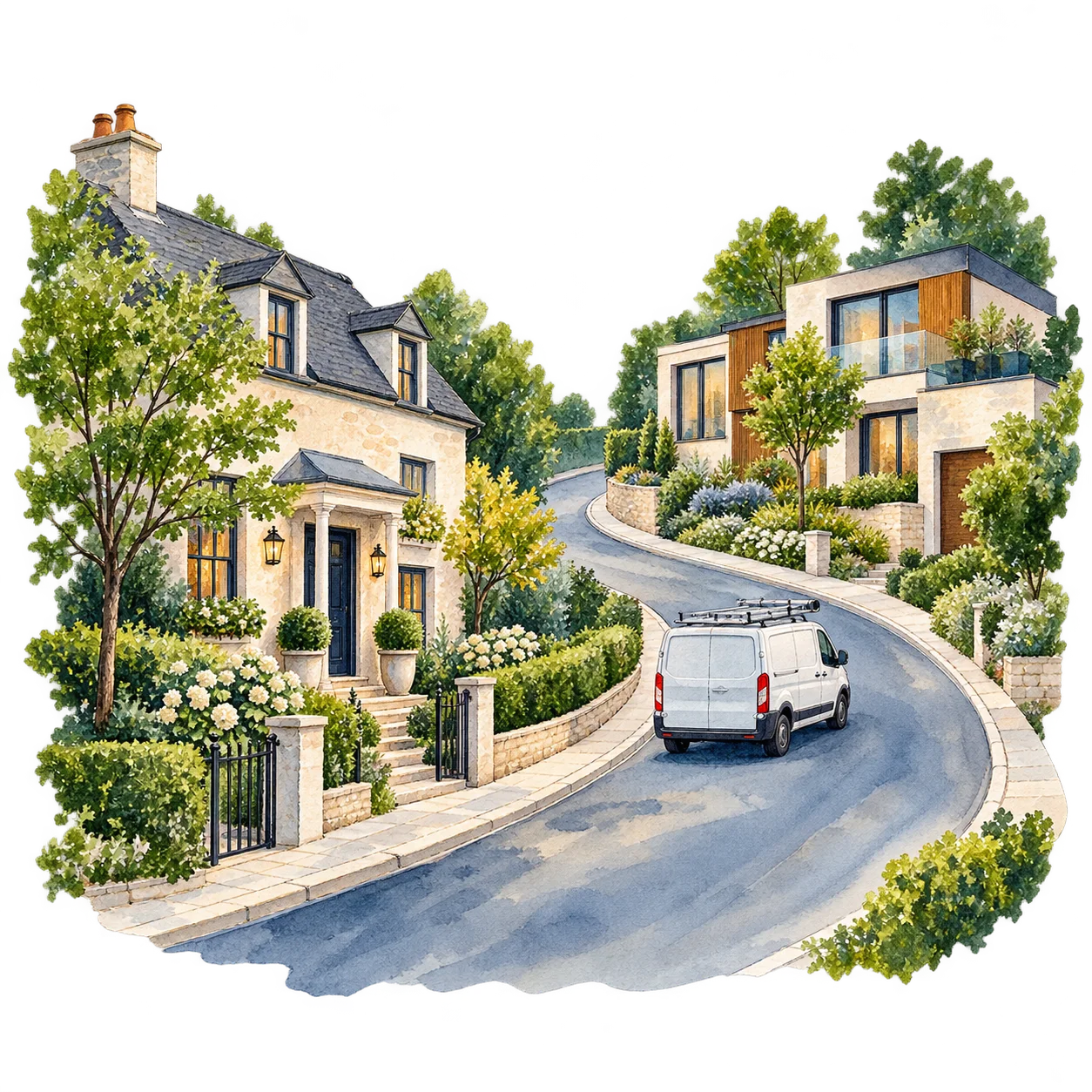
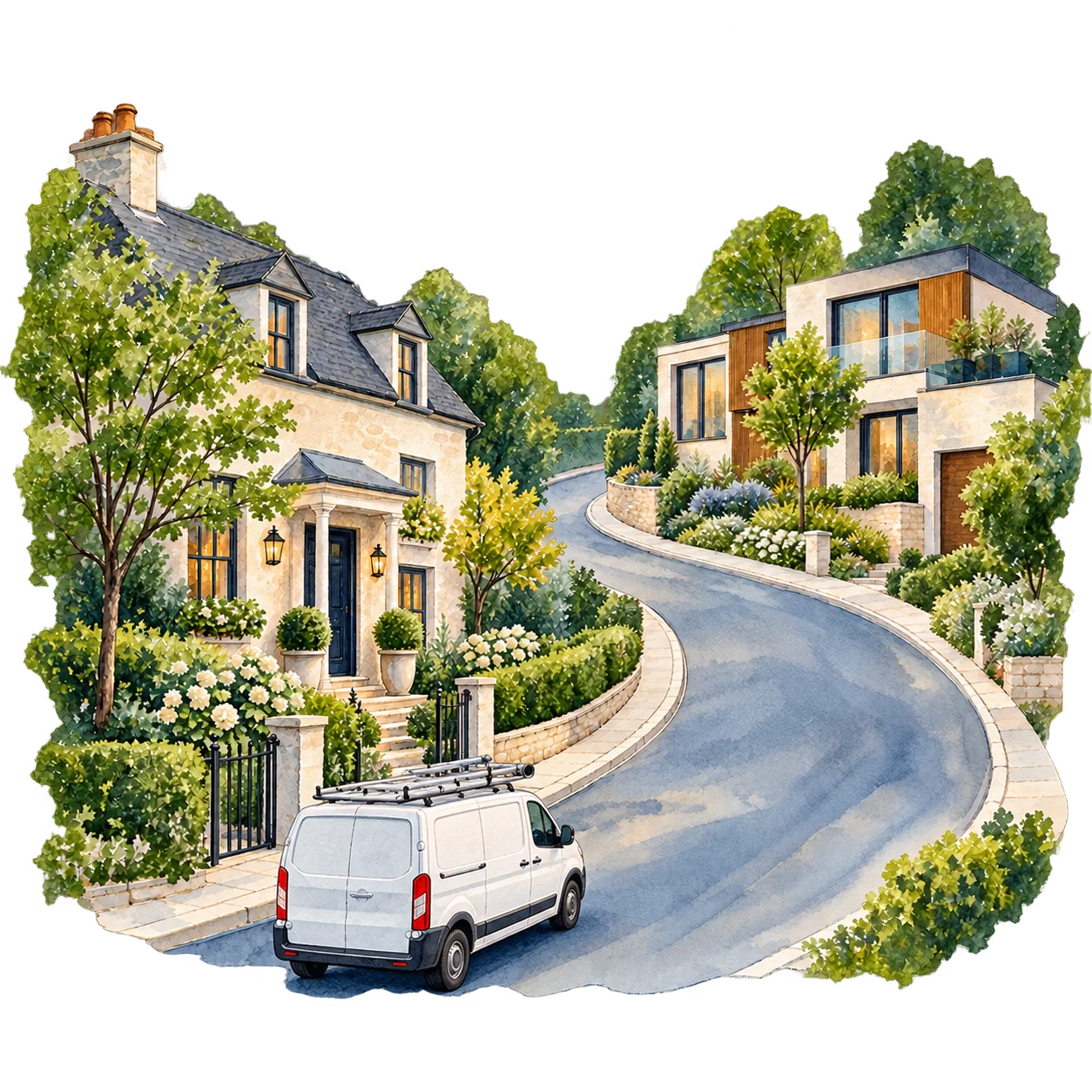
A service van travelling between two properties
The winding route fades and a shorter path between the same tasks appears.

Paperless operations

Keep the task, lose some of the paper.

Check-in sheets, house rules, worksheets, handover records, invoices and monthly summaries are often printed, then entered again later. A team can collect signatures and photos on a tablet and send invoices by email. The information remains available, while some of the paper handling falls away.

  • Digital check-in and e-signature, with nothing printed
  • Worksheets with photo evidence instead of a paper handover record
  • Invoices and monthly statements emailed and archived
  • Printing still works — it is just a decision now, not the default

Printed sheets / property / month

−94%

With paper administration34 sheets
With the digital process2 sheets
Related module
A stack of paper becoming a checklist on a tablet
Forms waiting beside the printer give way to tasks and signatures on the team’s tablet.

Building operations

Let an empty room rest.

The booking calendar already shows when a room is empty. Heating or cooling can then move to a lower-use setting and return to a comfortable temperature before arrival. A separate window can be planned for cleaning. Guests experience the comfort, without the energy use during empty hours.

  • Heating and cooling driven by the booking calendar
  • Timed pre-arrival warm-up, so the guest never feels the difference
  • A separate short comfort window for the cleaning slot
  • Verified departure: the air conditioning cannot be left running

Heating and cooling energy / property / month

−34%

With a fixed baseline setting62 kWh
With occupancy-driven control41 kWh
Related module
A building in section, with empty rooms falling back to setback
Occupied rooms remain comfortable; empty rooms move to a lower-use setting.

Remote operations

Some faults do not need a van.

A silent phone extension, a wrong call diversion or a stalled channel sync can often be fixed in the system. Remote access through PBX Manager, Cloud and Colab helps the team investigate there first. If equipment needs replacing, someone still visits; otherwise, a trip may be avoided.

  • Remote PBX and network configuration, with no call-out
  • Live logs and status, so the cause is visible instead of guessed at
  • Video-assisted guidance when the job genuinely needs hands
  • A visit only when hardware really has to be replaced

On-site call-outs / property / year

−87%

With on-site troubleshooting3.1 call-outs
With remote operations0.4 call-outs
Related module
A remote session from the office to the property, instead of a van
The fault is resolved while the service van stays parked this time.

Guest experience

Arrival details where the guest can find them.

Directions, house rules, access details and invoices often arrive on separate sheets or cards. ECHO makes them available on the guest’s phone, linked to the booking. Anyone who wants a paper copy can still have one; the rest do not have to carry a welcome pack.

  • A digital door key by QR code or PIN, with no plastic card
  • Directions, house rules and local tips in the guest's own language
  • Invoices and receipts by email, on no paper at all
  • Anyone who asks still gets a printed copy — but only them

Printed guest documents and key cards / booking

−86%

With a printed welcome pack7 items
With a digital welcome pack1 items
Related module
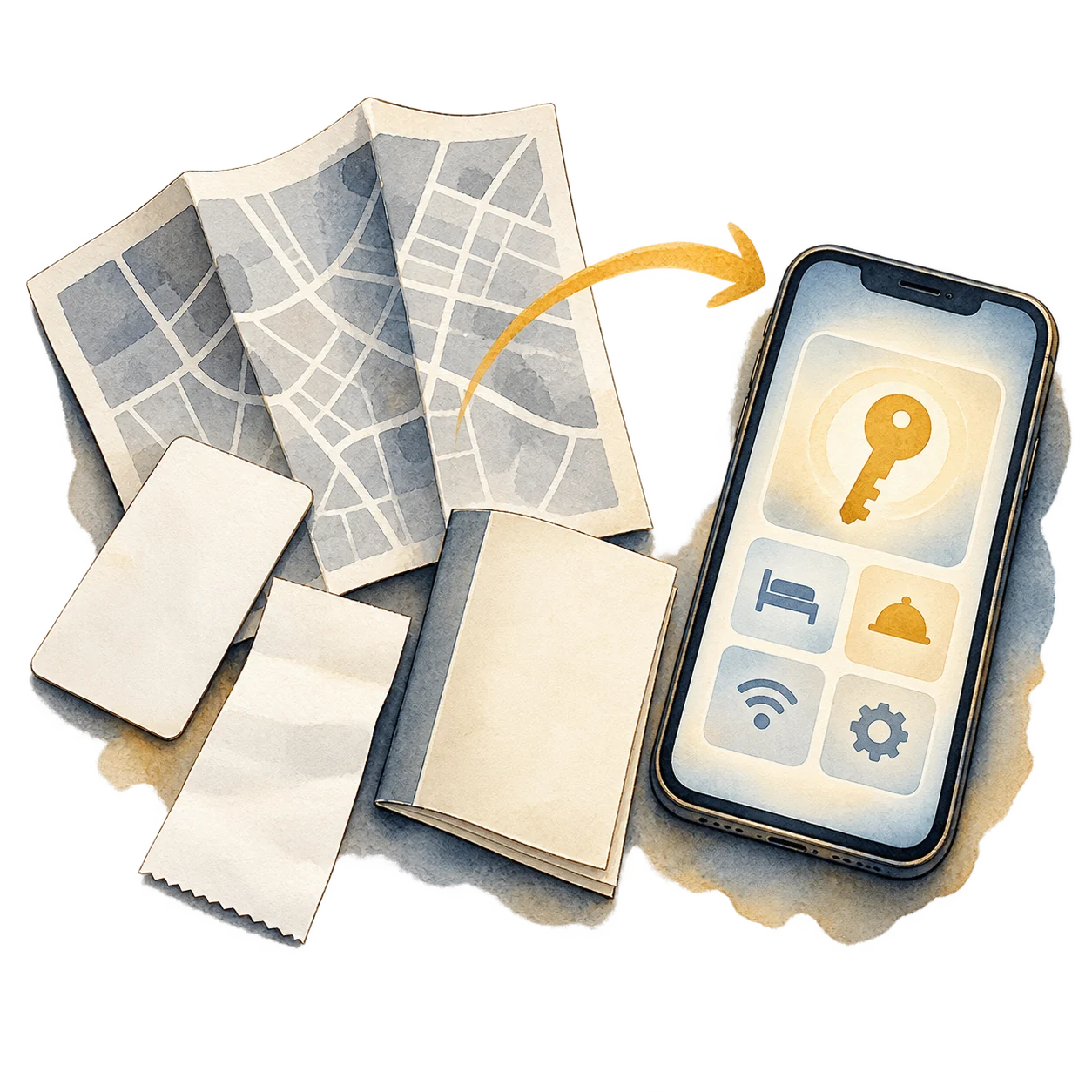
A digital key on a phone instead of a printed welcome pack
Printed sheets and a key card sit beside the phone, where the essential details are available.

Infrastructure

Do not leave five machines idling for one job.

Services on separate machines use power even when demand is low. Leviathan Cloud uses shared capacity in an EU data centre and adjusts resources to the load. The same work can run with less unused capacity.

  • Multi-tenant, right-sized instances instead of dedicated idle machines
  • Load-based scaling, with capacity handed back overnight
  • An EU data centre with documented energy efficiency
  • Data stays where the law does: inside the EU

Hosting energy / property / month

−67%

With a dedicated always-on machine4.8 kWh
With consolidated hosting1.6 kWh
Related module
Five servers becoming a single right-sized instance
Idle machines dim while the work remains on a right-sized system.

Transparency

How we arrived at the figures.

These figures come from a published model, not meter readings, and they have not been audited. The example uses a 12-property portfolio. Every input and assumption appears below; a different operation will produce a different result.

AssumptionValue usedNote
Reference portfolio12 properties, 3 field staff, 22 working days / monthA typical small-town apartment operator
Light commercial vehicle emissions0.19 kg CO₂e / kmDerived from average urban consumption for a diesel van
Electricity emissions0.23 kg CO₂e / kWhHungarian grid mix, indicative value
A4 sheet of paper5 g / sheet, 1.0 kg CO₂e / kgProduction only; transport and toner are excluded
Heating setback5 °C setback during vacant periodsApplied only to hours the booking calendar proves are vacant
Hosting energyPUE 1.2, with load-based scalingAs reported by the data centre operator
Length of one call-out26 km returnAverage across urban and suburban properties
Reference visit rate8 on-site visits / property / monthThe kilometres saved scale against this figure
Reference occupancy55%The remaining vacant time is what setback can act on
What we did not countdevice manufacture, equipment life cycle, guest travelThese do not arise within our scope

We buy no carbon offsets and we do not call ourselves carbon neutral. The figures above are modelled estimates; wherever measured data exists we mark it as such. If you find a flaw in the derivation, write to us — we will correct it.

Our own house

We look at our own choices too.

We can only speak credibly about a property’s footprint if we also examine how we work. The points below describe our current practice, rather than future pledges.

  • EU data centre

    Our services run in an EU data centre with documented energy use. We do not keep a transatlantic copy continuously in sync.

  • Right-sized runtime

    We shut test environments down overnight and at weekends. Automated checks run for the parts that have actually changed.

  • Remote by default

    We do not keep an office that everyone has to commute to. When we meet a customer in person, we try to combine several errands in one trip.

  • Long hardware life

    We use work machines for at least five years, repairing and upgrading them along the way. Retired machines are refurbished and passed on.

  • No printed marketing

    We do not make flyers, roll-ups or conference giveaways. We provide documentation and proposals digitally.

  • A light front end

    Our public pages use optimised images and few third-party scripts. We watch the amount of data transferred because that also takes energy.

The whole picture

People and data belong in the picture too.

ESG does not stop at energy use. A daily schedule affects people’s time; handling guest information involves trust. We therefore look at environmental, social and governance questions together.

E

Environmental

Fewer trips and printed pages, lower use in empty rooms, and better-used infrastructure.

  • Optimised field rounds
  • Paperless administration
  • Occupancy-driven energy control
  • EU-based, right-sized hosting

S

Social

A realistic day’s schedule can mean less rushing and less avoidable overtime for the team.

  • Achievable daily schedules built on real travel time
  • Transparent worksheets and proof of completion for staff
  • Interface available in Hungarian, English and Spanish
  • Accessibility target: WCAG 2.2 level AA

G

Governance

Guest and employee data comes with responsibility. Who can access it, and why, matters.

  • Data stored inside the EU and processed under the GDPR
  • A publicly listed set of sub-processors
  • An auditable log of every access
  • Guest data is never sold or further analysed

Data for your report

When you need figures for a report.

Larger hotel groups and partners may ask for sustainability data, and some customers have legal reporting duties. Routes, worksheets, consumption figures and document records already arise during daily operations. They can be gathered for a report.

  • Kilometres driven and call-out counts per property, broken down by period
  • The ratio of printed to digitally handled documents
  • Consumption data from connected meters and thermostats
  • Machine-readable CSV and PDF exports for the report itself

We provide the raw data. Interpretation and audit belong to the people preparing the report.

Commitments

What comes next, with dates.

See what is finished, what is in progress and what we plan. If a date changes, we will show it here.

  1. 2026 Q2

    Round planning in every Flow subscription

    Round planning is included in the basic Flow service; it does not need a separate package.

    Done

  2. 2026 Q4

    ESG export from the dashboard

    Distance, paper use and consumption figures can be exported from one place as CSV and PDF files.

    In progress

  3. 2027 Q2

    Measured data instead of modelled

    Data from smart meters and thermostats could give the energy calculation a measurement in place of a modelled estimate.

    Planned

  4. 2027 Q4

    Certified renewable hosting

    We plan to move the full runtime to an EU data centre using certified renewable electricity.

    Planned

Run the numbers

What does the model show for your portfolio?

Enter your own figures and the same published model will use them. The calculation runs in your browser; the values are not sent or stored.

The portfolio

12
8visits
6
55%

The longer a room stands empty, the more heating energy there is to release.

Which modules would you use?

Modelled annual saving

0kg CO₂e

Emissions avoided in one year

Where it comes from

Emissions avoided per measure, kg CO₂e / year